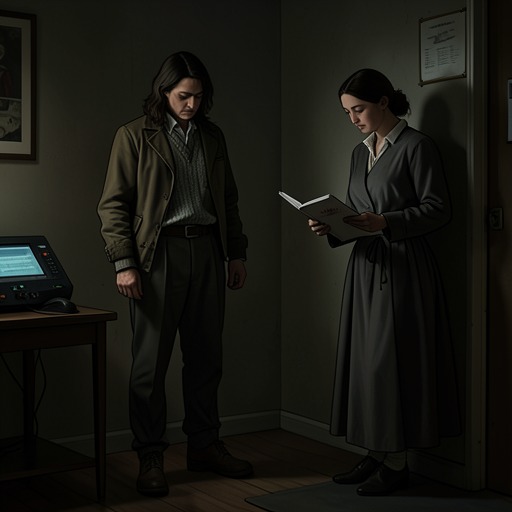
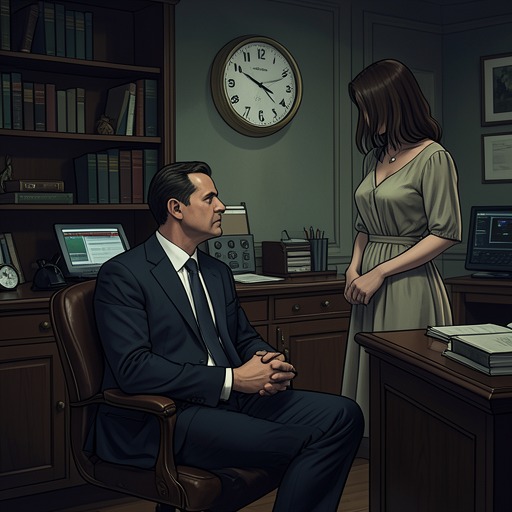
Celia Favreau and Bill Compton’s friendship and working relationship
All the Old KnivesCelia Favreau and Bill Compton’s friendship and working relationship becomes consequential again when Bill calls Celia after Henry Pelham questions him about the Flughafen investigation. Their exchange is both a reunion between former colleagues and an urgent warning: Bill recognizes that Henry is narrowing his suspicions toward Celia, whose earlier concealment of the call-log check has also left Bill outside the truth. Familiarity survives the years apart, but trust now has to operate amid surveillance, withheld information, and immediate danger.
An Old Connection Reopened
Bill’s call begins with recognition before it reaches business. He addresses Celia as Cee, and his voice seems old and far away to her; when he identifies himself, she briefly mistakes the moment for a dream. The hesitation conveys the distance between them without erasing their intimacy. Celia has not heard his name in years, yet their exchange quickly recovers a familiar register: she asks how he is, and he tells her she sounds well. Their ease is not proof that nothing has changed. Rather, the abrupt movement from tentative recognition to serious concern shows how an old personal bond can become active again under pressure.
The circumstances of Celia’s life make that distance concrete. She has spent five years on the edge of the continent, building a different existence in Carmel-by-the-Sea around marriage, children, and new responsibilities. She does not regard the past as erased, but says the Agency has largely left her alone. Her contact with Karl Stein—a visit shortly after the family’s arrival and a later phone call about the capture of an enemy—has been exceptional. Bill’s call therefore crosses the boundary between the life she has built and the intelligence world she had come to think was no longer intruding.
The Investigation and the Warning
Bill explains that Henry came to London and put him through an intense round of questioning. The stated subject was 127, Bill’s shorthand for the Flughafen. Henry claimed that someone in Lyon wanted a full report, but Bill made inquiries and concluded that this explanation was false: the investigation was internal. The distinction matters to their relationship because Bill is not merely passing along office news. He has tested Henry’s account and is trying to warn Celia about what the questioning is really doing.
At first, Bill says he thought the scrutiny meant that he himself was under attack. Only after Henry left did he understand the encounter differently. Henry had asked about Celia, and Bill realized that Henry was checking whether Bill knew she had examined the logs. Since Bill did not know, Henry could use that ignorance to narrow his list of suspects. Bill’s conclusion is direct: Henry is moving toward Celia. The warning turns their call into a transfer of risk-relevant knowledge, based on Bill’s reconstruction of Henry’s questions rather than on a formal instruction from the Agency.
Trust, Concealment, and Care
The call also exposes a fracture between the friends. When Bill asks whether Celia checked the logs and covered it up, she confirms both facts. He asks why she did not tell him; she admits that she should have. Her answers are spare, and Bill does not pretend the concealment was harmless. Yet he explicitly says that he did not call to berate her. He is calling to warn her. That choice defines the relationship more sharply than a general claim of loyalty would: although Celia withheld information that bears directly on the investigation, Bill uses what he has learned to protect her rather than to punish or expose her.
Celia, in turn, treats Bill’s concern as credible. She says she believes she has little reason to fear retaliation after years away, but also recognizes that Bill would not raise the alarm without good cause. Her confidence in her new life does not amount to dismissal of his judgment. When he explains that Henry has focused on her, she accepts the implication and thanks him. The exchange thus holds two truths together: Celia’s decision to conceal the log check has damaged openness between them, while Bill’s warning demonstrates a continuing personal commitment that survives that breach.
An Unresolved Return to Danger
The form of the conversation makes their renewed connection precarious. Celia realizes they are speaking on an open line and wonders whether someone in a landscaping truck nearby might be listening. The possibility changes an intimate call into a potential source of evidence. She tries to recall what they have already said, but her racing heart distracts her. Even as Bill offers help, the medium itself threatens to expose them.
The call ends not with a plan or resolution but with Celia’s daughter, Ginny, calling for her. Celia thanks Bill, says she will keep watch, and leaves the conversation to go to Ginny. That interruption returns her to the family life she had described, but it does not settle the danger Bill has identified. Their friendship is therefore renewed in a narrow, consequential form: an old colleague reaches across years of separation to warn her, and Celia accepts the warning just as the home she has made and the past she thought dormant occupy the same moment.